Precise Glycan Editing
We develop spatiotemporally resolved, substrate-selective editing tools and interface-level interventions along both protein-glycan and RNA-glycan axes to enable precise glycan control in defined biological contexts.
We focus on the chemical biology of functional assemblies. Our work follows a "read–edit–engineer" framework along two axes — glycans on proteins and glycans on RNA — and turns mechanistic understanding into controllable cellular programmes and disease interventions.
The glycome underpins molecular interaction and information flow in living systems. Along the protein- and RNA-glycan axes, we ask three questions in sequence: can we edit glycans precisely? how do their functions unfold? and can we convert that knowledge into diagnostics and therapeutics?
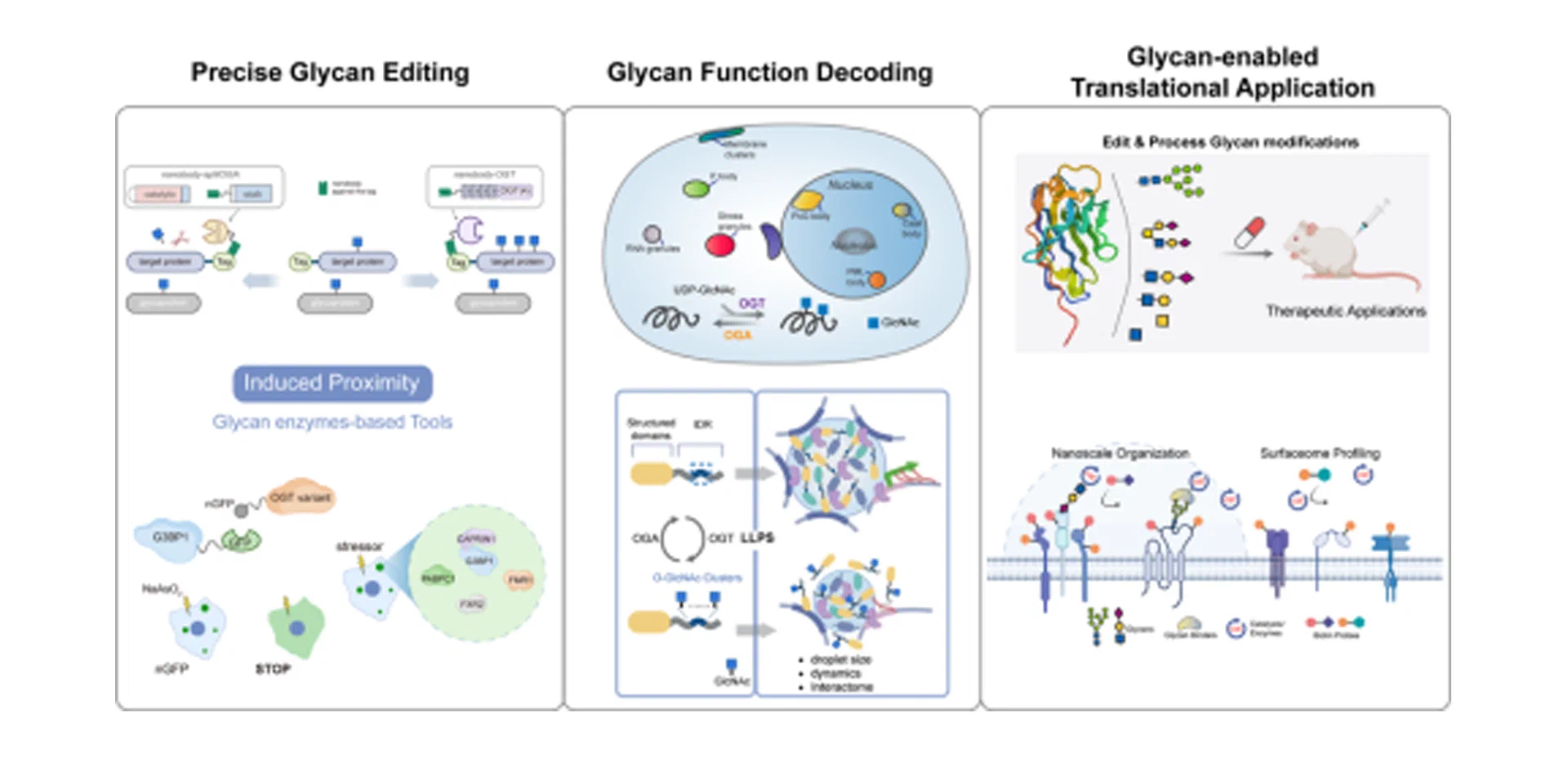
We develop spatiotemporally resolved, substrate-selective editing tools and interface-level interventions along both protein-glycan and RNA-glycan axes to enable precise glycan control in defined biological contexts.
Using interdisciplinary chemical-biology tools, we dissect functional interactions between glycans and proteins/RNA in defined spatial and state contexts — from biomolecular condensates to the plasma membrane — and study how glycans shape transcription, translation, and other fundamental cellular processes.
We map functional microenvironments co-assembled by glycans and other macromolecules, and design systematic profiling and intervention strategies for disease diagnosis and therapy — from glycan-editing-enhanced tumour immunity to new cell-surface markers, glycan-mediated interactions, and glycan-enabled biologics.
Every paper, preprint, and citation count, kept up to date.