
Precise Glycan Editing
We develop spatiotemporally resolved, substrate-selective editing tools and interface-level interventions along both protein-glycan and RNA-glycan axes to enable precise glycan control in defined biological contexts.
We follow a read–edit–engineer framework along the protein- and RNA-glycan axes — building precise glycan-editing tools, decoding glycan function in biomolecular condensates and cellular processes, and converting that knowledge into therapeutic strategies such as tumour immunotherapy.
The glycome underpins molecular interaction and information flow in living systems. Along the protein- and RNA-glycan axes, we ask three questions in sequence: can we edit glycans precisely? how do their functions unfold? and can we convert that knowledge into diagnostics and therapeutics?
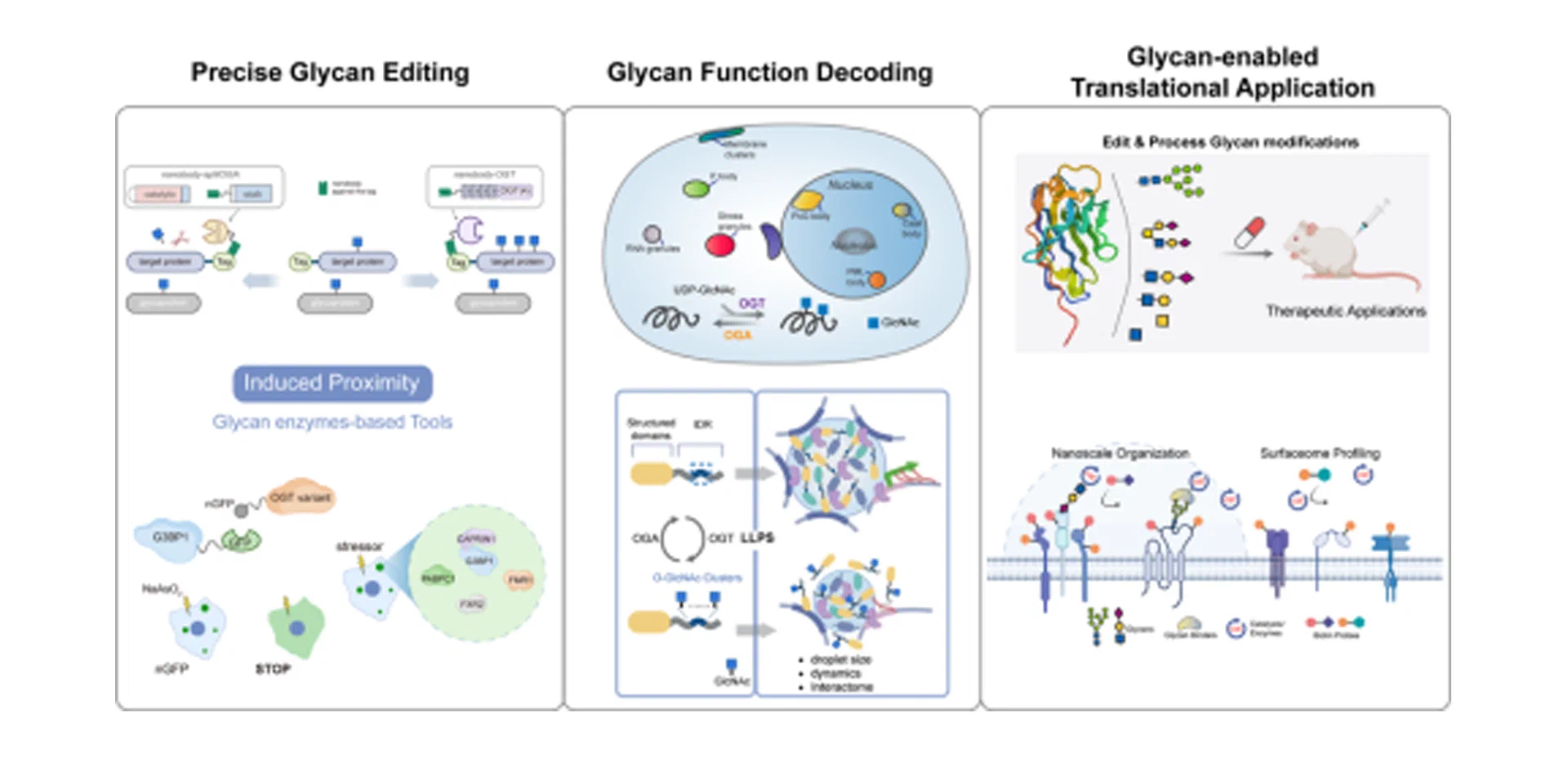
We develop spatiotemporally resolved, substrate-selective editing tools and interface-level interventions along both protein-glycan and RNA-glycan axes to enable precise glycan control in defined biological contexts.
Using interdisciplinary chemical-biology tools, we dissect functional interactions between glycans and proteins/RNA in defined spatial and state contexts — from biomolecular condensates to the plasma membrane — and study how glycans shape transcription, translation, and other fundamental cellular processes.
We map functional microenvironments co-assembled by glycans and other macromolecules, and design systematic profiling and intervention strategies for disease diagnosis and therapy — from glycan-editing-enhanced tumour immunity to new cell-surface markers, glycan-mediated interactions, and glycan-enabled biologics.
We identify a previously unappreciated regulatory role of O-GlcNAc clusters located within intrinsically disordered regions of transcriptional regulators. These glycan clusters modulate the material properties of transcriptional condensates and downstream gene-control programmes.
In collaboration with Prof. Jun Liu's team, we report that O-GlcNAc clusters within disordered regions of transcriptional regulators control the material properties of …
Postdoctoral fellow Silan Liu shares the story behind her work on strategies that detect and manipulate cell-surface glycans.
Wang Na, our jointly-supervised PhD student, received an excellent poster award at the 19th session of the 35th Annual Meeting of the Chinese Chemical Society.
Our Nature Communications paper reveals a non-catalytic function of OGT that enables targeted regulation of stress granules.
We are recruiting postdocs, PhD students, jointly-supervised PhD students, and research assistants. Reach out to discuss.
